
VACUUM CONTROL MADE SIMPLE.
Integrated systems for critical HV/UHV environments
THE OPKI solution
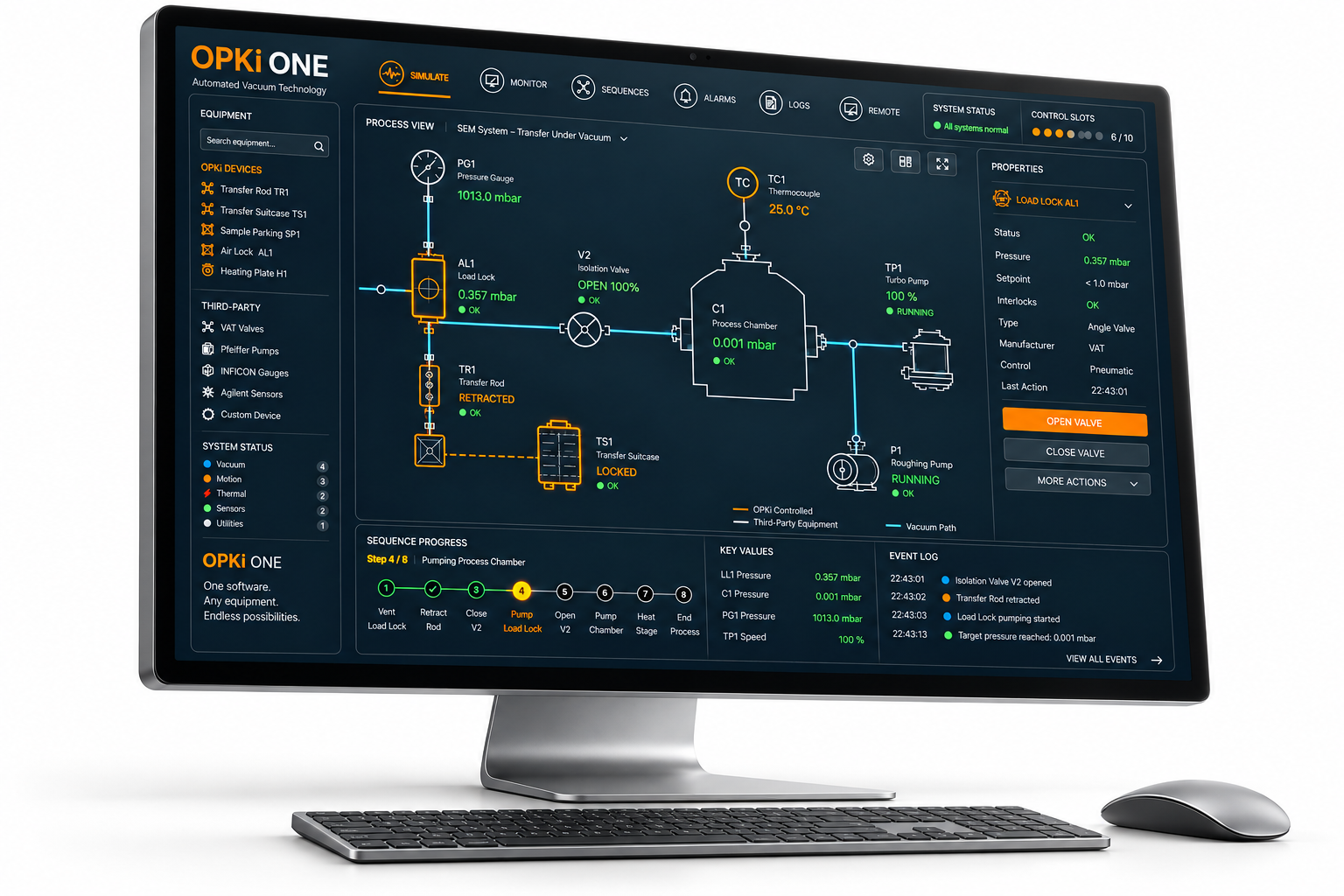
Modular, Controlled by a single software program
OPKI structures the vacuum into system bricks designed to be combined, secured, and operated over time. Each brick covers a critical use, while integrating into a controlled overall architecture.
A single control layer unifies existing and future equipment, enabling teams to build their own sequences – or rely on OPKI – while keeping full control over operations.
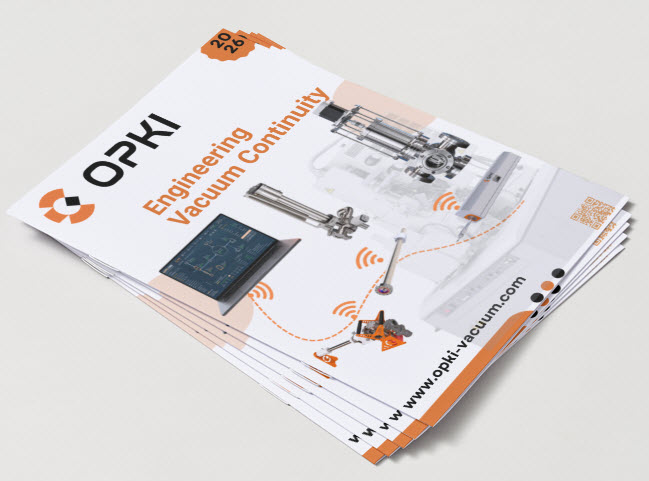
Download the brochure

why control matters
When vacuum performance becomes critical
In HV and UHV environments, vacuum is not a background condition. It directly impacts sample integrity, process reliability and experimental outcomes.
Yet most setups still rely on fragmented components and discontinuous practices, where performance depends on individual expertise rather than on a controlled system.
This is where the Vacuum Performance Chain starts to matter.
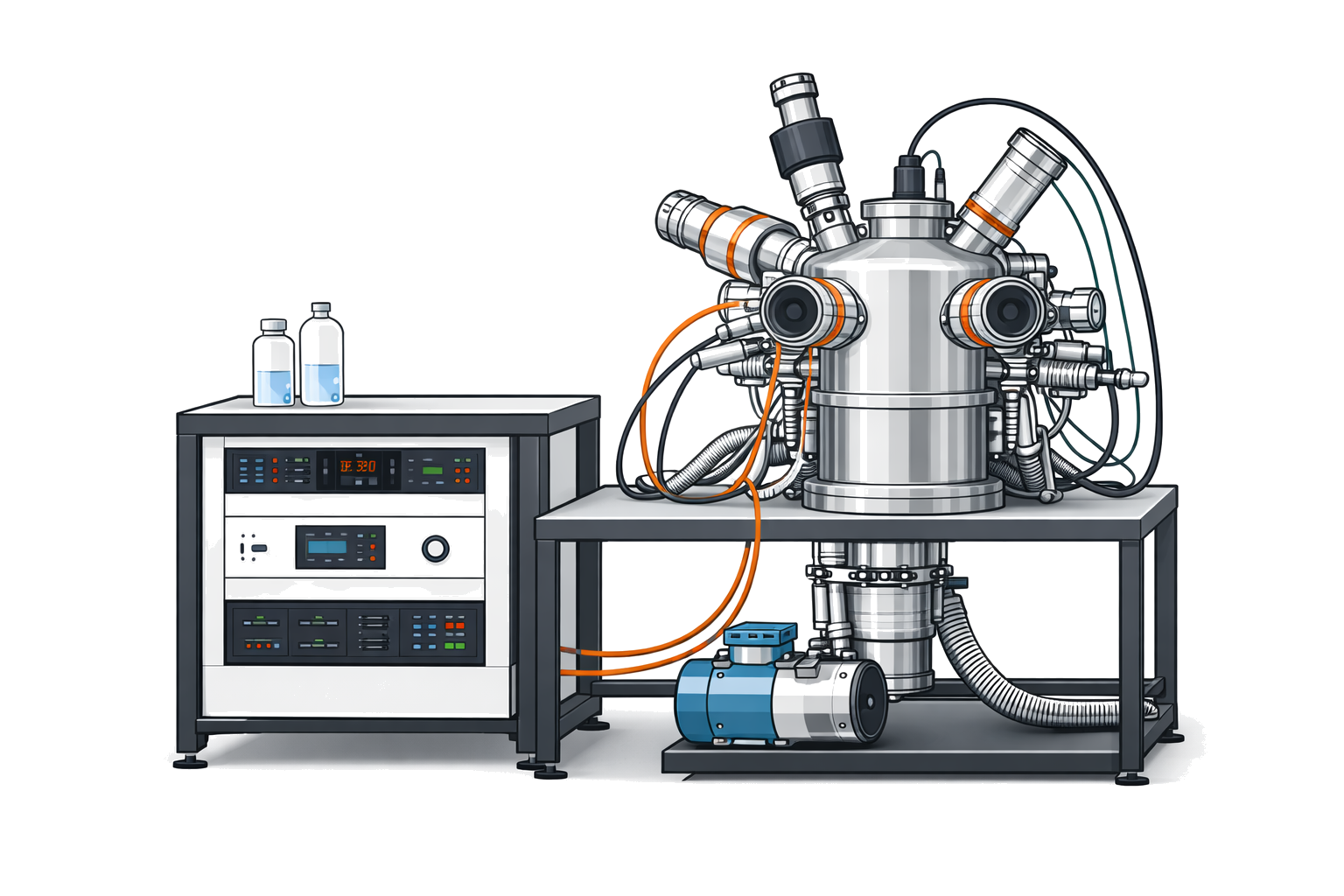
Manual, fragmented processes with limited control and reproducibility

Fragmented systems
Equipment is purchased separately, leading to complex integration and compatibility issues.
Reliability & safety risks
Operator-dependent handling increases variability, sample contamination, and equipment damage.
Non-standardized operations
Procedures differ between teams, making processes hard to stabilize.

Limited automation & reproducibility
Custom automation is costly, difficult to retrofit, and rarely scalable end-to-end.
THE OPKI APPROACH
From components to a controlled system
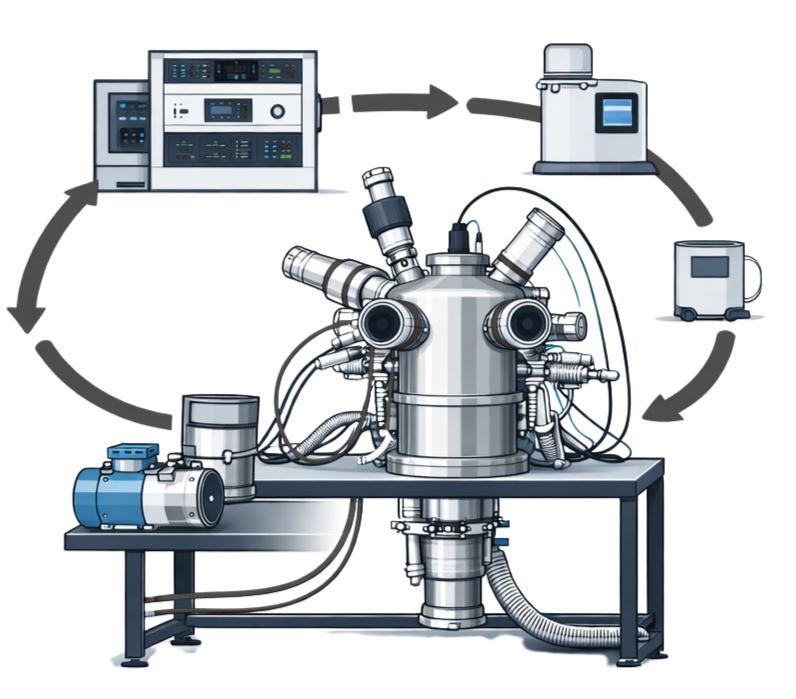
OPKI designs vacuum solutions by connecting products, procedures and usage into a coherent operational chain:
The Vacuum Performance Chain™.
Some projects start from a specific product. Others from a system-level requirement.
In all cases, performance comes from control across the whole chain, not from isolated equipment.
WHY A SYSTEM?
Vacuum performance is not a component issue
In critical environments, vacuum performance does not depend on a single piece of hardware. It emerges from the interaction between components, handling and procedures.
Subtle breaks in this chain – contamination, mechanical stress, variability – are often the source of lost reliability, limited reproducibility and increased risk.
The OPKI system views vacuum as a continuous operational chain rather than a set of isolated solutions. It is this system approach that we call the Vacuum Performance Chain™.
THE OPKI SYSTEM
Products designed to work together
OPKI products can be deployed independently or integrated into a complete system architecture :
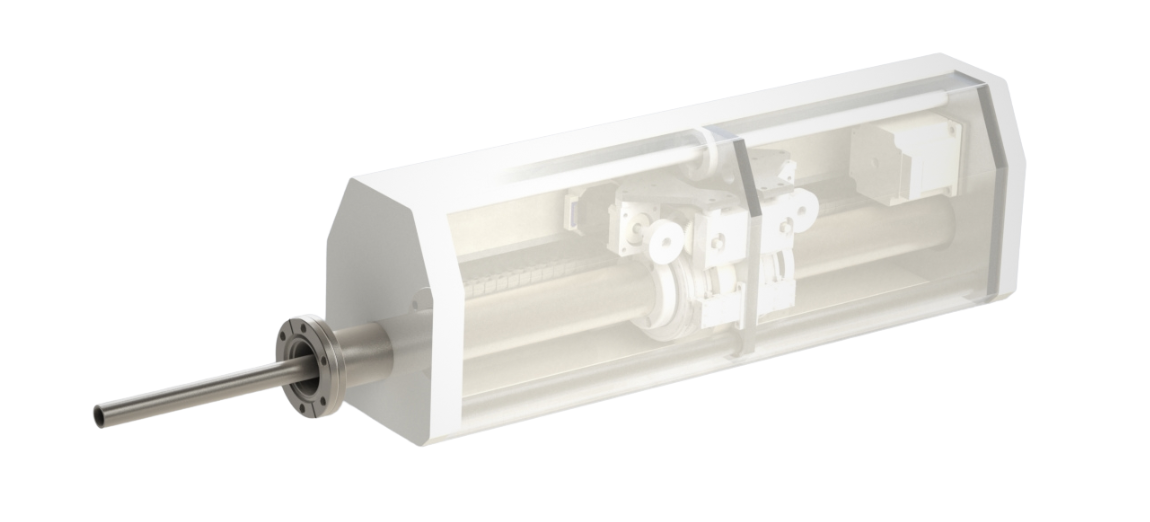
- Transfer rods (manual & motorized)
- UHV modules & interfaces
- Chambers & load-locks
- Operational continuity tools
- Software & sequences
Designed to work together. Adaptable to existing setups.
The opki method
Designing reference architectures for critical vacuum
OPKI doesn’t start from products. It starts from real use case and critical constraints.
By designing reference vacuum architectures, OPKI transforms expert know-how into repeatable, controllable systems, ready for operation and long-term use.
Applications
Where control cannot fail
OPKI operates wherever a loss of vacuum creates a technical, scientific or economic risk.



NEXT STEP
Let’s talk about control
Every vacuum environment has its own constraints.
We help you determine where control really matters and how to design the right system.
Talk to an OPKI engineer →

Define where control really matters
OPKI designs vacuum systems for critical HV / UHV environments. By structuring products, procedures and architectures as a coherent whole, OPKI helps research and industry maintain control across the Vacuum Performance Chain™, where vacuum performance truly matters.
contact@opki-vacuum.com
Make an appointment with an OPKI engineer